
Virtual Reality in Education: Transforming Learning Through Immersive Technology
Education is undergoing a digital transformation, and virtual reality in education (VR) is leading the charge. By immersing students in engaging, hands-on experiences, VR is redefining how knowledge is delivered and retained.
In this article
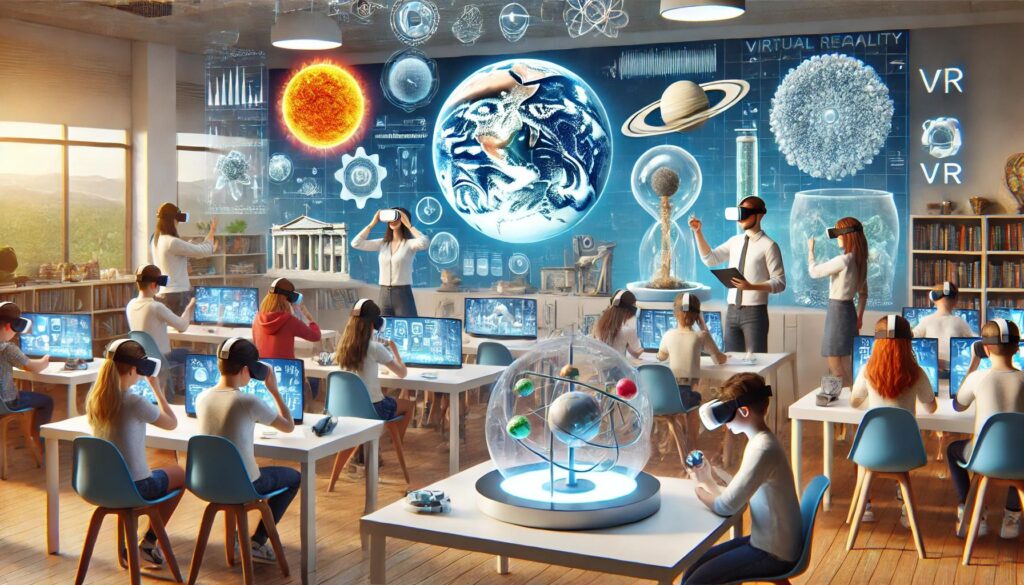
From exploring the depths of the ocean to walking through ancient civilizations, VR allows students to learn in ways that were once unimaginable.
In this article, we’ll explore the benefits of VR in education, discuss top tools revolutionizing the classroom, and highlight how educators can effectively incorporate this technology.
1. What is Virtual Reality in Education?
Virtual reality in education uses immersive technology to create simulated environments where students can interact and learn. Unlike traditional methods, VR allows learners to be part of the experience, making lessons more engaging and memorable.
Examples of VR Applications:
- Visiting historic sites in history lessons.
- Conducting virtual science experiments without the risks of a real lab.
Experiencing real-world applications of physics, biology, or geography.
2. Benefits of Virtual Reality in Education
a. Enhanced Engagement and Motivation
Traditional lectures can often fail to capture a student’s attention. VR captivates learners by immersing them in the subject matter, making lessons exciting and interactive.
b. Hands-On Learning Without Risks
For subjects like chemistry or engineering, VR allows students to perform complex experiments safely. For example, students can assemble machinery or work with hazardous materials in a risk-free virtual environment.
c. Breaking Geographical Barriers
Field trips to iconic places can be expensive and logistically challenging. With VR, students can explore world-class museums, natural wonders, or even outer space from their classrooms.
d. Catering to Different Learning Styles
Whether a student learns best through visuals, touch, or exploration, VR accommodates diverse learning preferences. It’s especially effective for visual and kinesthetic learners.
e. Increasing Retention Rates
Studies show that interactive, immersive experiences significantly improve knowledge retention compared to passive learning methods.
3. Top Virtual Reality Tools for Education
a. Google Expeditions
Google Expeditions enables teachers to take students on virtual field trips to over 900 destinations. From the Great Wall of China to the surface of Mars, students can explore in 360-degree detail.
Key Features:
- Guided tours led by teachers.
- Compatible with affordable VR headsets like Google Cardboard.
Learn more about Google Expeditions.
b. Nearpod
Nearpod is an interactive platform that integrates VR to deliver virtual field trips and immersive lessons directly into classrooms. Teachers can guide students through activities and quizzes in real time.
Key Features:
- Combines VR with quizzes and interactive lessons.
- Allows teachers to track student progress during sessions.
Check out Nearpod.
c. Engage VR
Engage VR offers a virtual classroom experience where teachers and students can collaborate in a shared environment. It’s particularly effective for remote learning.
Key Features:
- Customizable virtual classrooms.
- Supports collaboration and group projects.
Visit Engage VR for details.
d. Labster
Labster offers virtual science labs for students, enabling them to conduct experiments in subjects like biology, chemistry, and physics.
Key Features:
- Realistic lab simulations.
- Cost-effective alternative to physical labs.
Discover Labster.
4. Real-World Examples of VR in Education
a. Medical Training
Medical schools are using VR simulations to teach surgical procedures. Students can practice operations repeatedly without risking patient safety.
b. Language Learning
Immersive VR environments help students practice conversations in real-world settings, like ordering food in a Parisian café or asking for directions in Tokyo.
c. Special Education
VR creates safe, controlled environments for students with special needs, allowing them to develop social skills or practice daily routines.
5. Challenges of Virtual Reality in Education
While the benefits of VR are immense, it’s important to consider its challenges:
a. Cost
High-quality VR headsets and software can be expensive, making it difficult for all schools to adopt the technology.
b. Accessibility
Not all students have access to the devices needed for VR, creating a potential digital divide.
c. Content Availability
Although VR is growing, content tailored to specific curriculums is still limited, requiring teachers to invest time in creating or sourcing materials.
d. Technology Learning Curve
Both teachers and students may require training to effectively use VR tools.
Have you read – Accelerate your Educational Journey with AI?
6. How to Incorporate VR in the Classroom
Here are some steps for teachers and schools to integrate VR into their teaching strategies:
a. Start Small
Begin with affordable VR solutions like Google Cardboard, which works with a smartphone, before investing in advanced tools.
b. Align with Learning Goals
Use VR tools that complement your curriculum, such as Labster for science or Expeditions for history lessons.
c. Encourage Collaboration
Pair students for VR activities to foster teamwork and reduce the need for individual devices.
d. Provide Teacher Training
Ensure teachers understand how to use VR technology effectively to maximize its benefits.
7. The Future of Virtual Reality in Education
As VR technology becomes more accessible and affordable, its adoption in education is expected to grow. Emerging trends include:
- AI Integration: Combining VR with artificial intelligence to provide personalized learning experiences.
- Cross-Disciplinary Use: Expanding VR to arts, business studies, and even philosophy.
- Global Collaboration: Virtual classrooms where students from different countries collaborate in real time.
Conclusion: Embracing Virtual Reality in Education
Virtual reality in education is no longer a futuristic concept; it’s a powerful tool shaping the way students learn today. By breaking barriers of geography, cost, and engagement, VR is making education more accessible, interactive, and effective.
Whether you’re a teacher exploring new methods or a school considering VR adoption, the time to embrace this transformative technology is now. From Google Expeditions to Labster, the tools are ready—are you?
Frequently Asked Questions
What is artificial intelligence in simple terms?
AI is the simulation of human intelligence by machines, allowing them to perform tasks like learning, decision-making, and problem-solving.
What are examples of AI in everyday life?
Examples include smart assistants (like Alexa), personalized recommendations on Netflix, and AI-powered chatbots.
Is AI difficult for beginners to learn?
Not at all! Beginners can start with simple courses and tools to grasp the basics of AI.
How does AI impact jobs?
While AI automates repetitive tasks, it also creates opportunities in fields like AI development, data analysis, and robotics.




2 Responses